
As we’ve outlined in previous articles, good decision-making is one of the critical determinants of an organization’s success. Good decisions are aligned with the company’s vision and strategy, have a positive return on investment, and are made quickly and efficiently. Furthermore, companies that empower their employees to make more decisions make better decisions ( both in terms of quality and efficiency) and outperform their peers financially.
The challenge for leaders who want to empower their employees is that many of them aren’t equipped to make sound business decisions for two reasons:
- Few people receive formal training in decision-making, in particular, making decisions where cost-benefit or economic analysis is required. It’s just not part of the standard curriculum in our education system, other than business courses. As a result, they don’t understand critical concepts like marginal analysis, the time value of money, and direct/indirect costs.
- Our brains are not wired to be good at making decisions involving complexity and uncertainty. Our thought processes are subject to cognitive bias. We need to apply specific tools within our decision-making process to identify and avoid these “decision traps.”
One strategy for overcoming this is implementing a standard “Decision-Making Framework” across the organization. Utilizing a Decision-Making Framework helps overcome common “decision traps” by forcing discipline in decision-making. Following is the 7-Step Decision-Making Framework that I have used throughout my career and taught to my teams.
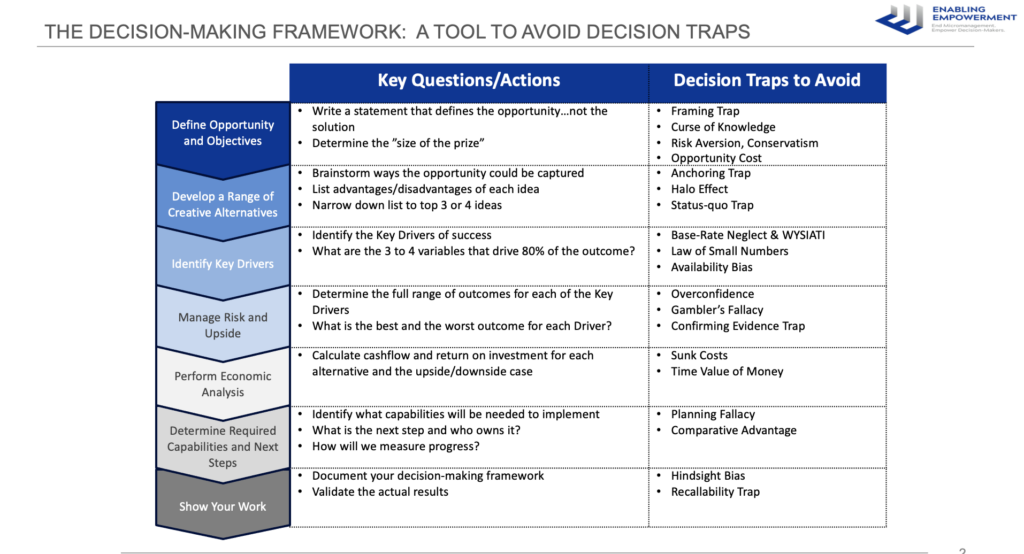
In subsequent articles, we will dive deeper into each step of the Decision-Making Framework and discuss the best practices for avoiding some of the most common decision traps. Make sure you like this article and follow our page to see those articles in your feed.
In the meantime, here is a link to a webinar where we overview the Decision-Making Framework, demonstrate some common decision traps, and provide some best practices.
Are you seeking to enable your team to make better decisions? talk with Chris.